

How To Draw Person Tied Up
Agreement the figure
To depict a pose correctly, you lot don't need to always conduct an anatomy volume with y'all. Information technology'south not as difficult as it seems: ascertainment and practice are your all-time tools. If at whatsoever point you get curious about trying something new (which I promise you practice), it never hurts to take a look at that beefcake book.
Even if your cartoon manner is far from realistic, the aspects that brand a pose interesting and credible remain the same: strength, rhythm, action lines, construction and perspective.
Observation:
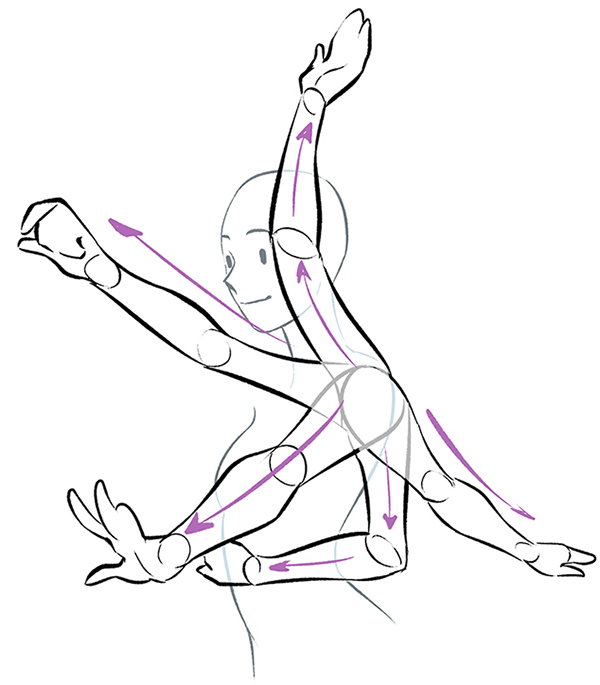
Your closest reference is yourself. If you look at yourself in front of a mirror and get-go moving, you will notice that your body works as a single chemical element.
When you raise an arm, the arm is not the simply function of your body that moves, unlike how the removable extremities of dolls work. The changes in your body don't resemble figure A, right? For example, your shoulder also lifts, and many other parts of your body adapt to the movement as in figure B.
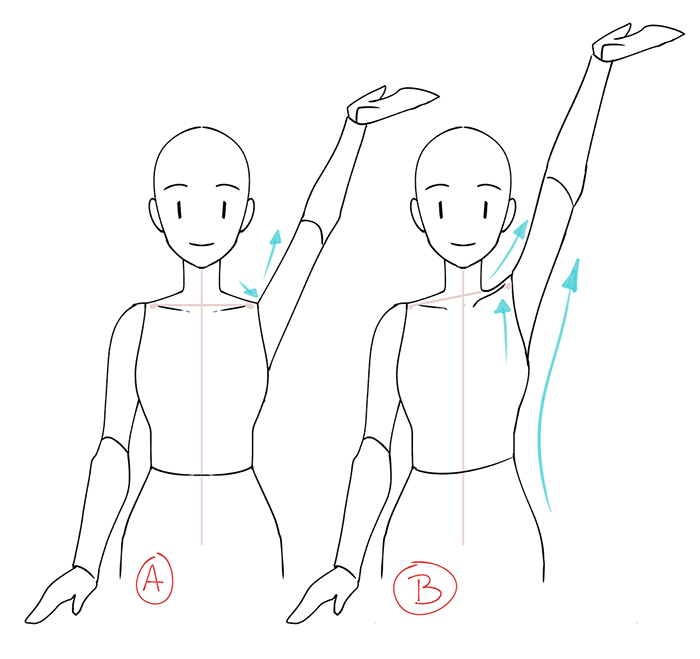
This is what observation ways: paying attention to the details and characteristics of the body.
Strength and rhythm
Your characters motility thank you to their inner strength. They can walk, jump, trip the light fantastic… whatever comes to listen! But unless they are floating in infinite, it is not the but force that acts on them, as gravity makes their anxiety stay on country.
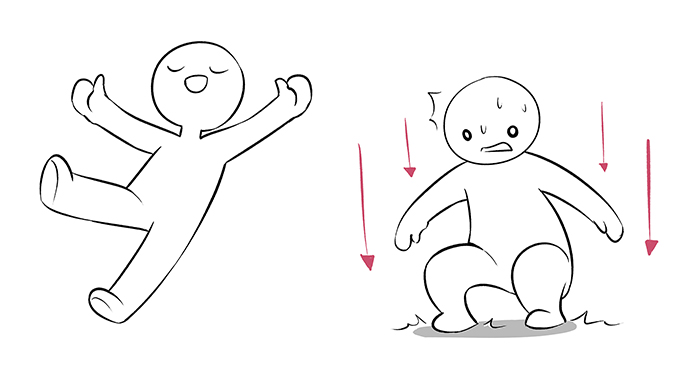
When two or more forces interact with each other, a rhythm is set, which provides residue and sense to the movement.
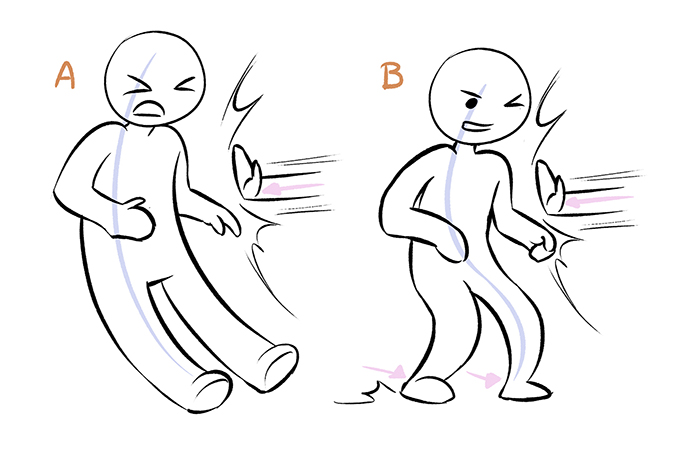
If your character is pushed to the left, his body will autumn in that direction (A), unless he puts up resistance to stand (B).
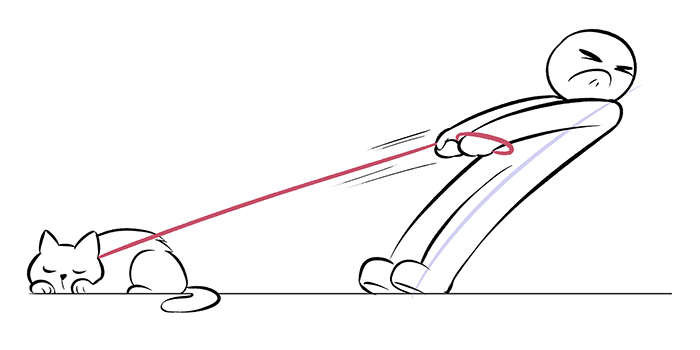
If the character wants to pull something that refuses to motion, his trunk will lean in the opposite direction. Plainly, once the true cat gives in to the force, your character will autumn, as the cat was what kept him standing.
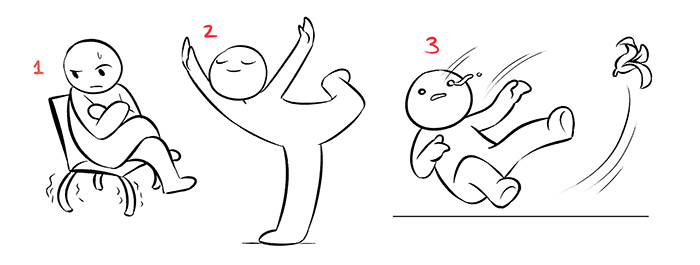
Force and rhythm provide a lot of visual information you can piece of work with: the weight of your character (ane), the residuum of his pose (ii) or the lack of it (3).
Action lines
The action line is the imaginary guide that indicates your character'southward movement. It focuses on actions and helps to unify the whole figure.
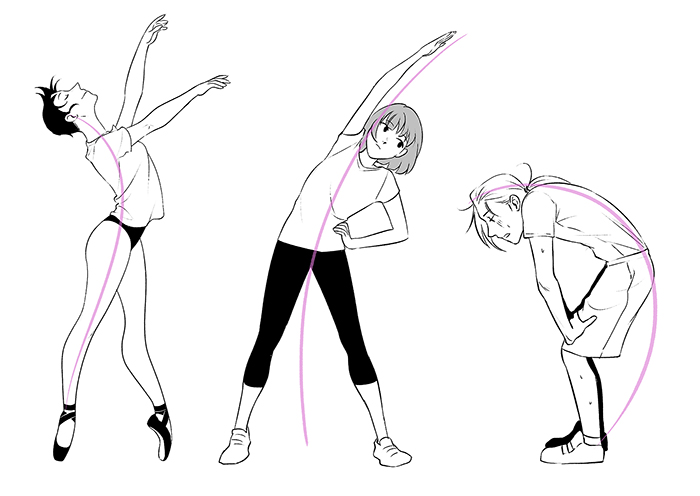
Below you can run into a couple of examples where strength, rhythm and action lines collaborate together.
Example 1:
The grapheme (1) has a relaxed stance, resting on her right arm. In the effigy (two), we can see her action line, which covers her whole torso upwardly to the foot. The shape is slightly similar to an S.
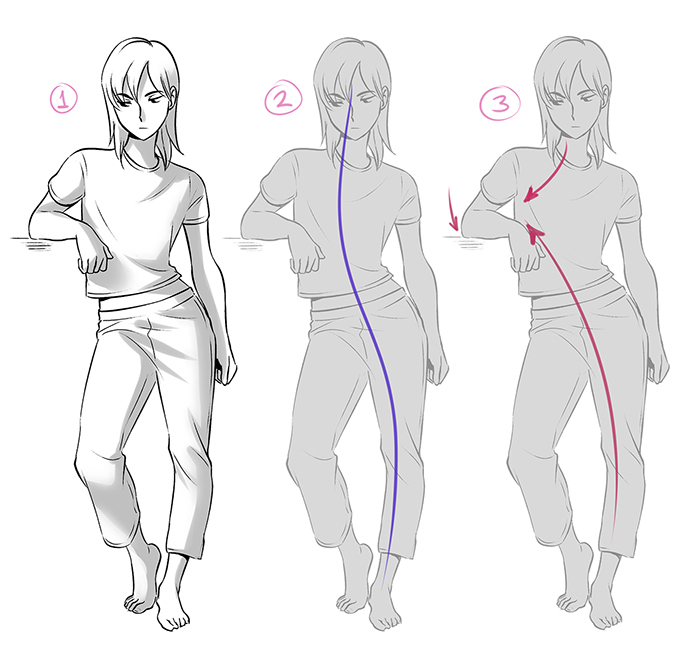
We can meet it is a relaxed pose because her weight rests on a unmarried point (3) and all she needs is to proceed the balance with her left foot, which remains taut while the right one is resting.
Example ii:
The next pose is more dynamic, then there are more things going on in this image.
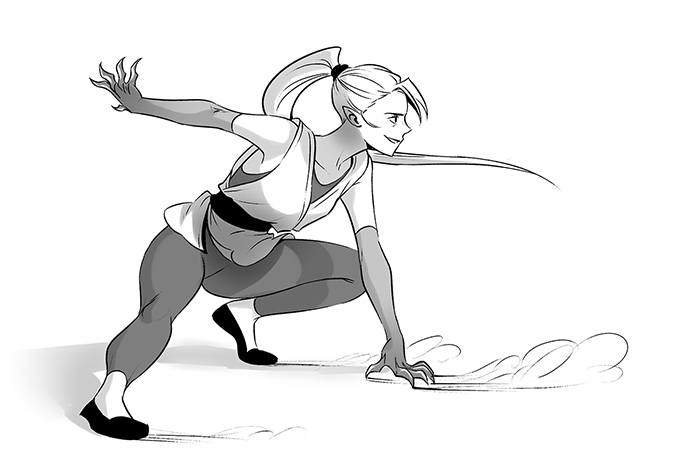
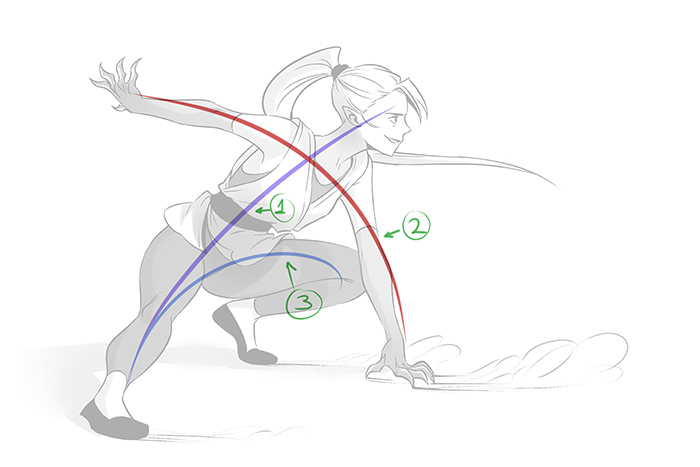
This time you lot can see three activeness lines, just the most of import are (ane) and (2), the ones that really tell the story. The first one covers the whole figure from head to toe, and the 2nd i goes in the opposite direction, keeping the balance and forming an X. The third i simply provides greater stability to the pose.
In this drawing nosotros can run into that there is a forcefulness that pushes the character in the opposite management to her gaze. Elements such as the hair, the clothes and the dust on the floor suggest that the force comes from the right side, and equally these elements are light, they are afflicted by the speed with which this force acts.
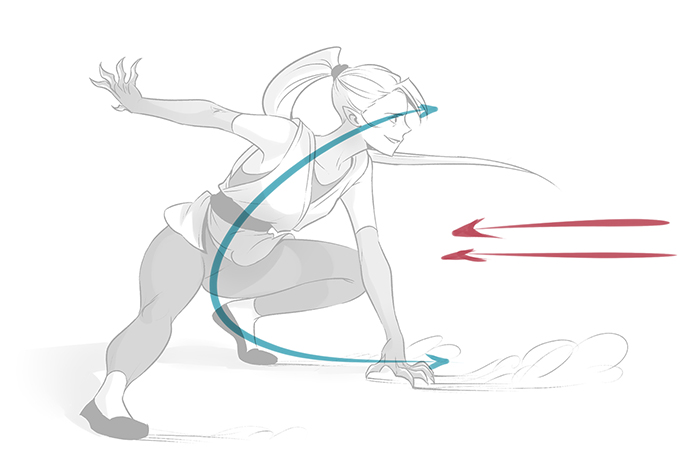
Yet, this girl wants to overcome this forcefulness with her own forcefulness. She has no intention of losing the fight.
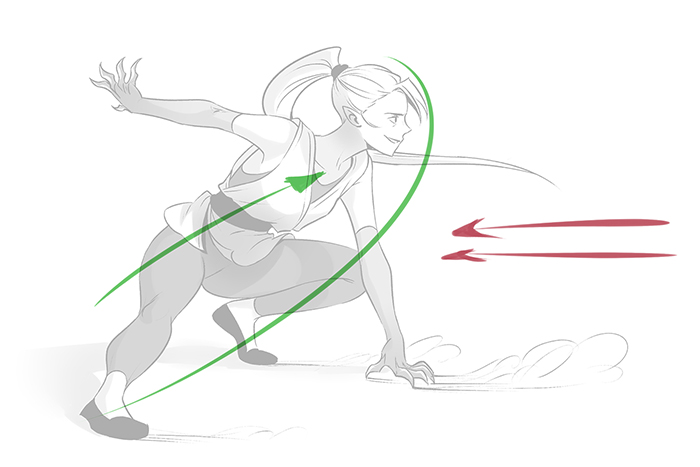
Example three:
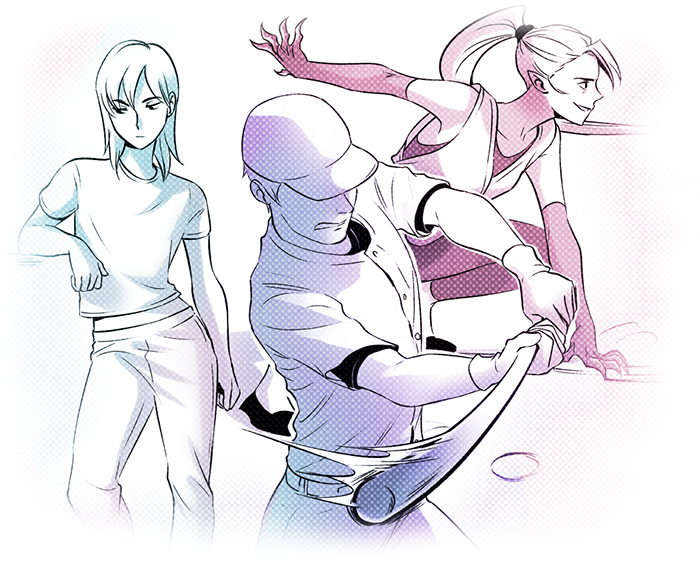
This fourth dimension, our character is a baseball actor. He's spinning his trunk to go enough momentum and counter the ball's force to hit it far away. Don't you get the impression that it will be a home run even though you haven't seen how the scene ends yet? It'south the magic of anticipation. If you know how to properly handle the force, rhythm, and action lines correctly, you lot will be able to guide the spectator along the path you accept set up. This is very of import for whatsoever comic artist.
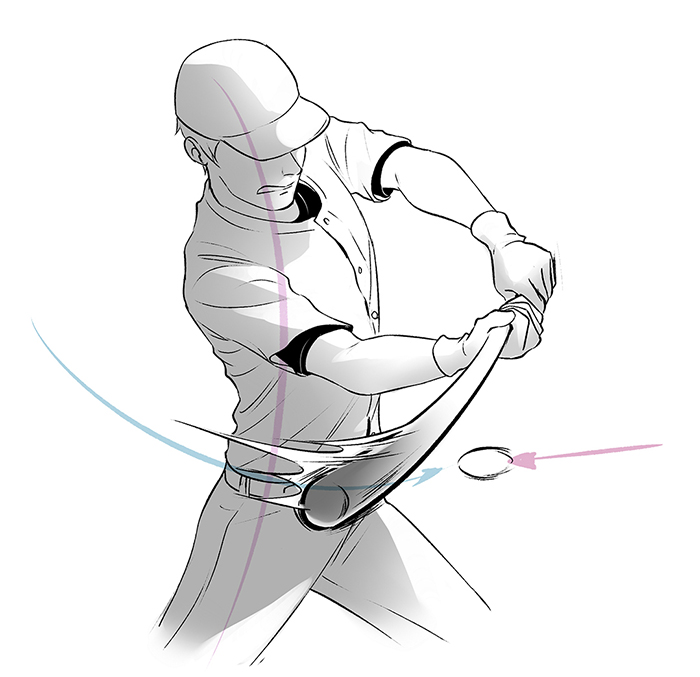
Information technology's important that you don't overpopulate your drawing with too many action lines, because it could confuse the character's intention, make the forcefulness go in dissimilar directions, and have the emphasis away from the most important activeness.
Construction
The body is quite complex and information technology is difficult to draw right proportions and move abroad from the 2nd plane. I recommend yous shape a base that helps you discern the volume of each element. To do this, nosotros will use geometric figures such as spheres, cubes and cylinders to represent the construction of the body.
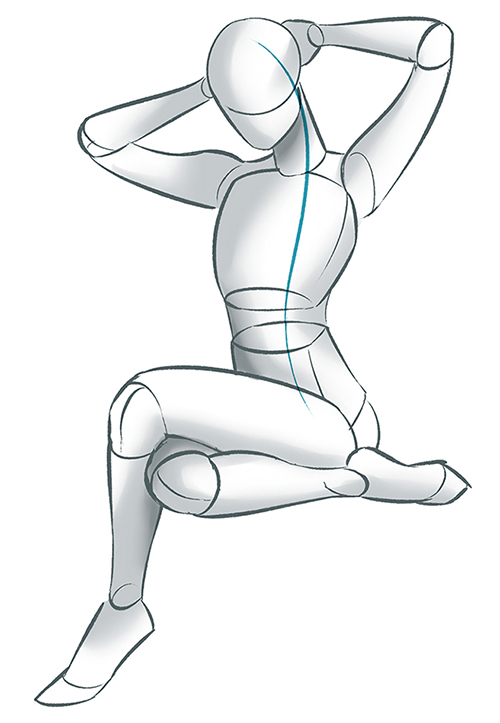
These figures tin be freely rotated, stretched, flexed, and twisted co-ordinate to the pose.
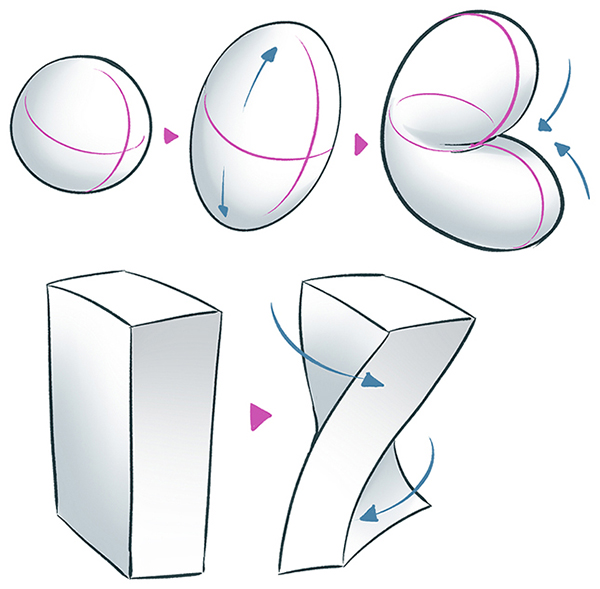
These figures represent the direction of the different elements of the body. You lot must pay special attending to the limits of the joints, since at a certain betoken you have to plough or twist the body to keep moving in that direction, changing drastically the pose.
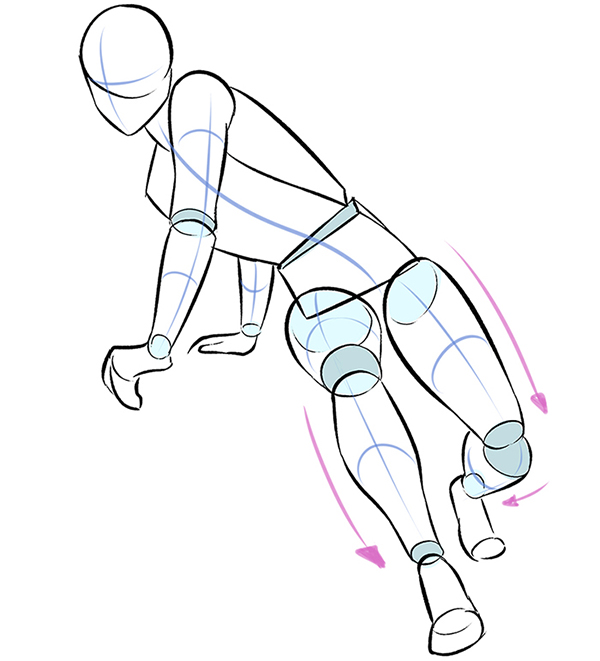
With practice, this process gets simpler. The better you lot sympathise how the figure works, the fewer guides you volition need.
Perspective
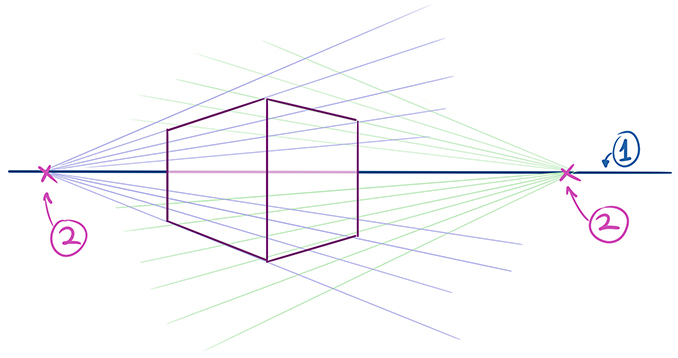
Perspective turns the 2nd aeroplane into a 3D one and adds more depth and visual richness to the composition than just looking at it from a frontal plane.
The centre level or horizon line represents the actual height of the viewer'southward optics (1), and the vanishing points are the lines projected from a bespeak on the horizon (2). The post-obit image has a perspective with 2 vanishing points with which we tin can appreciate 2 faces of the figure.
The body is more intricate, but the principle is the same. For example, this effigy's feet and hands are smaller due to the perspective, and fifty-fifty propose united states of america how we should project the vanishing point lines.
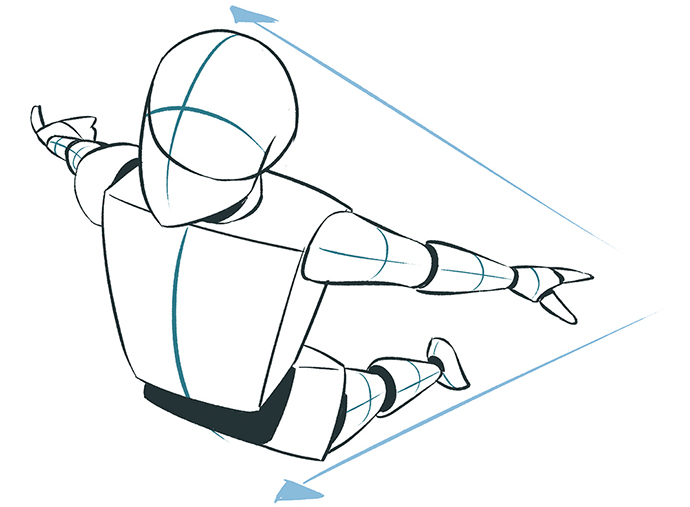
Action poses e'er look more dramatic when the perspective is exaggerated. Even when the poses are non entirely realistic, the figures seem credible and the scenes look more than interesting.
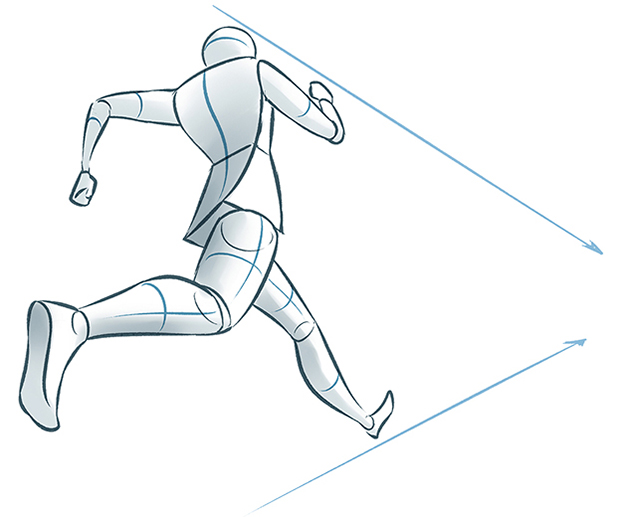
I recommend you to practice and read near perspective as much as possible, as it is not something yous can master in a mean solar day. Clarify equally many references every bit you can. Somewhen, you'll finish up seeing vanishing points everywhere.
Essential lines
You can speed up and better your ascertainment skills by drawing poses using photos or bodily people every bit a reference and setting a curt time limit for information technology. The aim is to capture the essential data of the figure and, of course, to draw every bit many poses as possible.
This exercise will too aid you to increase your conviction when drawing. Don't exist afraid to draw the first line, and even if yous make a mistake, avoid erasing the lines. Effort to focus and draw clean, clear lines.
Below yous can see some examples of poses that I accept fatigued within 45 to 60 seconds:
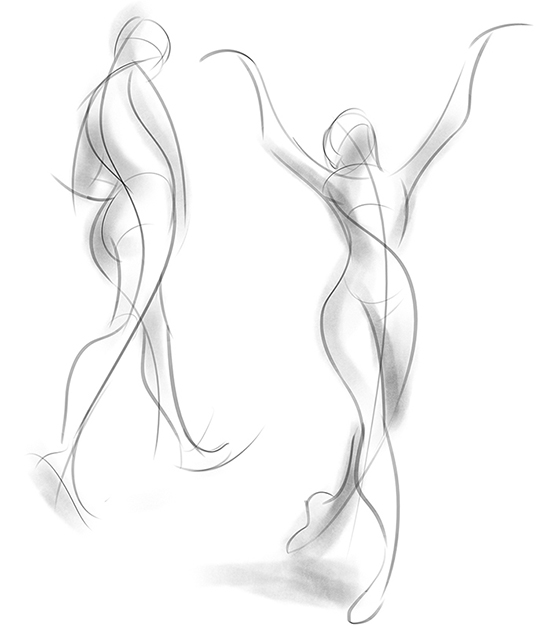
At kickoff, focus on drawing the whole body with smooth lines. Then, if y'all accept more time, particular and build the shape better.
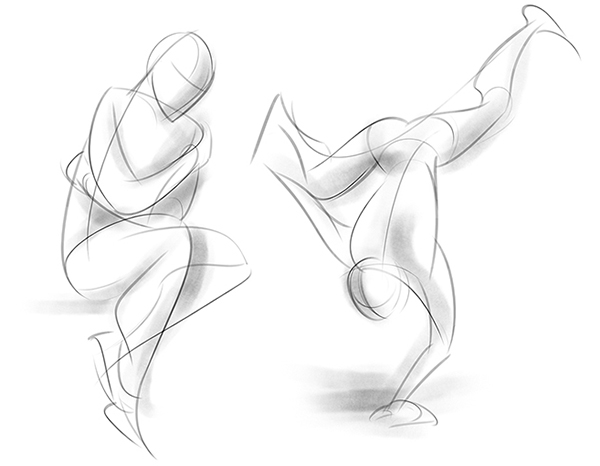
Don't be agape to draw what you don't see or what is hidden, as it will give you a better idea of the figure'south structure.
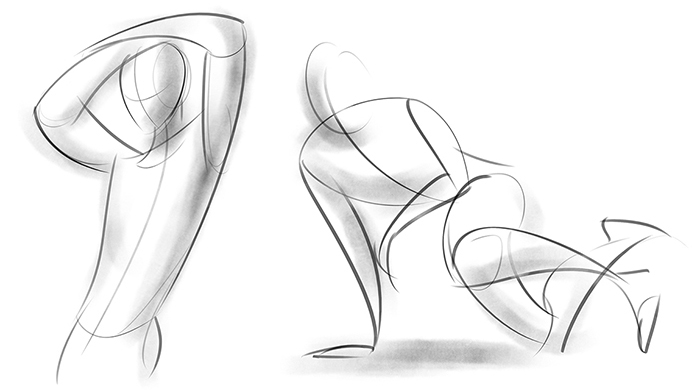
Endeavor to exaggerate the lines. It makes them softer and more credible, however crazy it sounds.
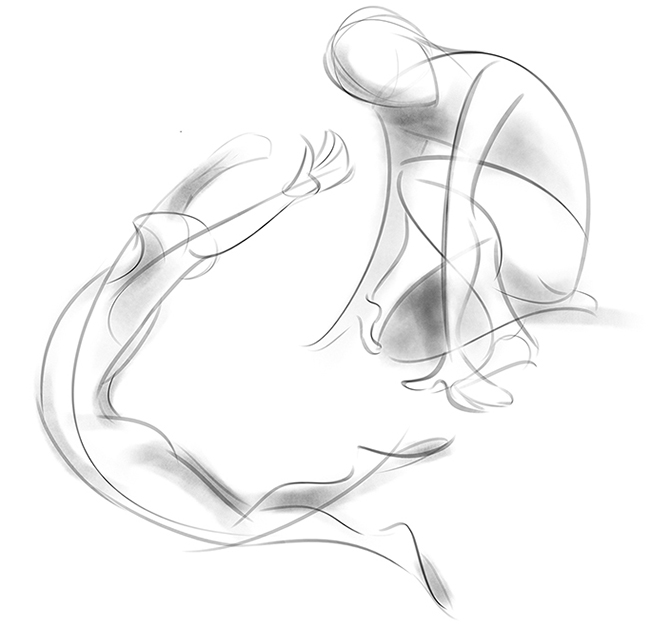
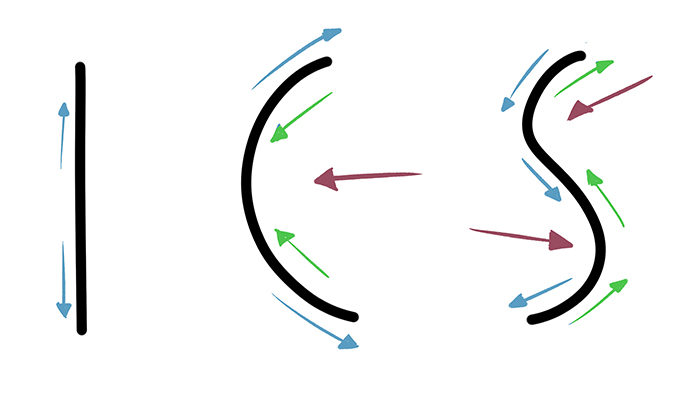
Unless the model is in a very rigid posture, try to avoid straight lines. The about natural poses are built with curves.
I hope these tips have been helpful!
If you desire to meet more of my work, from these links you tin access my social media pages and my portfolio:
https://www.instagram.com/eri_duh/
https://twitter.com/eri_duh
https://world wide web.artstation.com/eridey
Cheers so much for reading this article!
– Eridey

Source: https://www.clipstudio.net/how-to-draw/archives/156164
Posted by: rollinspritterpron.blogspot.com
0 Response to "How To Draw Person Tied Up"
Post a Comment